3P's lessons plans

martes, 11 de agosto de 2015

Feelings and Emotions Activities for Elementary ESL

 Link to the resource:
                                  Watch the video of the resource:


The shapes and adjectives of emotions or feelings book: here´s a book to review shapes and colors. Students will fill in the blanks with a feelings word and draw the mouth expression accordingly. There´s another version where students will also fill in the shape word. Nice to cover the vocabulary and grammar.

adjectives of emotions or feelings book

The family and feelings book: students will review family members as they draw the mouth expression and write the feeling. This is also included in the family blog post and TPT unit.

Feelings Clip Board: use it in your literacy center for active learning. Students can independently put the clip word corresponding to the picture. They can practice the new words and solve the problem at his/her own pace.
I glued the word onto wood clothespin.

Monsters Feeling Book: There´s a colored version to be used as a reader.  
There´s a second version to be used as a coloring book. Students have to read in order to color the monster by reviewing facial parts and colors. It will give children the opportunity to practice coloring inside the lines with patience and improving motor skills. Students will have to focus on each part of the face. 

I included puppets to along to identify emotions and name them.

Word wall: Display the pictures and words on the wall or bulletin board. Use it before, after or during reading or writing activities. It can be used individually, small groups or the whole class as a permanent reference to the new words creating a rich print environment.

I am adding the flashcards.

Trace the word cards: children learn to read  and spell faster when they write with their hand. The benefit with extend beyond the childhood years by preventing writing difficulties in the future.

Pocket chart: this activity teaches sight words and vocabulary. I use a commercially made pocket chart and make all the cards in the same format so you can mix them accordingly to your class. The pocket charts are not used enough in the English class, in most Latin countries they are not even available. If you make one I´d love to see it.

jueves, 7 de mayo de 2015

Mother´s Day Activities for Elementary ELL

LINK to this resource and more:

It is difficult to find easy activities for the Holiday.
 I designed a complete the book for Mom.

The pages are  for the children to complete following their mother´s characteristics.
 The numbers for the age. The children can cut images from magazines, bring pictures from home or draw their own pictures.

Photo booths and Props are popping everywhere, I made mine for Mother´s Day.
 Use them for greeting cards, fun classroom pictures for the year book or the celebration if you have one.
And very simple cards are included:

viernes, 1 de mayo de 2015

Body Theme for Elementary Language Learners

Get the files for the parts of the body resource for teaching Elementary English Language Learners at my Bilingual Marketplace store:
https://www.bilingualmarketplace.com/products/body-theme-for-elementary-ell?variant=37172657979556

 Watch the video of the resource:


Emotion, play and surprising activities are the secret ingredients to learning. This resource is help students describe the parts of the body and to describe people, family members and later on even animals.

Body unit draw book: Let them recognize that everybody in class is different.
Have the students draw  their bodies as they read the sentences. 
The grammar points are: possessive adjectives (This is my face) and demostratives (These are my legs)
Body unit draw book
Watch the video of the printable  book:

To learn Body Words Board Activity 1: Draw several shapes as torsos on the board . Have children come up to the complete the body.
Teacher: karla and Paul, draw the head.
Continue with more body parts until the drawing is complete. Go over all the body parts and label them.   Then, have children draw themselves with their complete bodies and label all their body parts.
learn Body Words Board Activity

Board Activity 2 Divide the class in several teams. Have a student from each team go to the board. Say a body vocabulary word and have the students write it on the board as fast as they can.  Give a point to each team that does it correctly. Continue with more words.

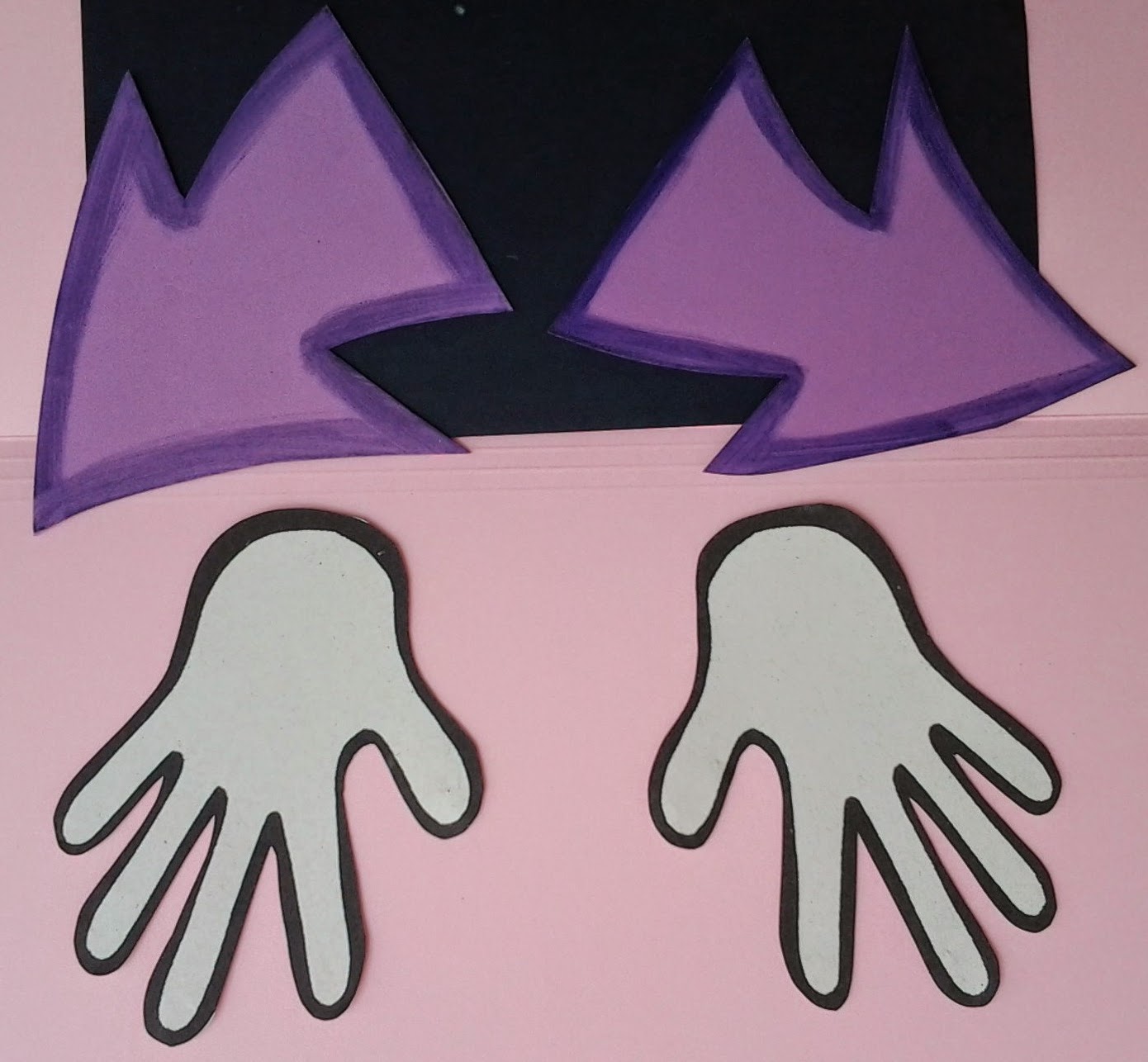
Children can count with their fingers. I printed onto cardboard  a right and left hand. Then I glued all the numbers onto clothespin. Students have to number all the fingers in the hand.
Body unit and the finger numbers
  
Adjectives Left and right related to the body: teach directionality during this unit. Have students hold both hands in front of themselves. Use the hands and arrows available for this purpose. You can make them smaller and paste the hands on their tables to remind them of left and right. Have students say right hand and show it to you. Do the same with left hand.
Adjectives Left and right related to the body

Pocket charts help children manipulate language in a special way. This time I included the adjectives Big and small as a sorting body part activity. if you don´t have a pocket chart do it on a file folder, on the table or the board.
adjectives Big and small as a sorting body part activity

Or make puppets with the feet, hand,arms cutouts and make big and small body parts patterns.
puppets with the feet, hand,arms cutouts

Another version, using complete sentences or making sentences.

Make words: print letters onto different colored paper or construction paper. Give students the letters to make body parts words as in a crossword.
make body parts words as in a crossword

Spelling: approach spelling as problem solving instead of a memorization activity. Teach spelling strategies and skills. Here are some ideas.

Task cards: motivate students with these cards instead of a regular worksheet. Students will have to deal with one question at a time instead of a whole page in front of him/her. I create the task cards with all the grammar points in mind and you can use the ones that suit your class. Use them to review before tests. Students can work individually or in pairs. Save paper by printing  and laminating the set. Students write on their notebooks.
Task cards body unit

Worksheet: there is no perfect worksheet for the body unit, but make changes to make it work. After I did the worksheet as in the instructions I cut everything out and created a label all activity by labelling the body parts and then the colors.
Worksheet body unit

Body Unit Domino game benefits group learning experiences and reinforcement of the new language.
Body Unit Domino

Body half game: print as many as you need. Give one half card to each child and have them walk around finding their other match and stand together. They can ask questions: Do you have the arm ? Make it a speaking activity.

Tracing helps with :
-       Eye-hand development and use of the writing tools: pencils, crayons, markers,etc
-     fine motor skills
      Develops the awareness of key concepts of print  in  the new language, even more when the language alphabet is completely different
-       teaches directionality about the ley movements for letter and word formation
-     The result is a neat worksheet or card that makes the child like independent handwriting that has been lost for the excessive use of technology.    
     Students can show the card and say: This is an eye.

s

Picture and word matching: this kind of activity help develop the word recognition skill necessary to reading. Students can see very letter in each word in his own work area instead of looking at it on the board that several meters away from him/her. Children need to focus on recognizing words readily  to move on to meaning.


                Follow me at my Facebook group!!   https://www.facebook.com/ESLPreschoolTeachers

domingo, 22 de marzo de 2015

Easter for Elementary ELL

Help your Elementary English Language Learners celebrate Easter with fun, language-building activities! In this post, you’ll find engaging classroom ideas and printable resources that practice vocabulary, reading, spelling, and collaboration. These activities are perfect for ESL/EFL and ELL classrooms in March and April.


Easter Small Cards — Match & Speak

Use Easter small cards to play Match the Pairs. Students observe, compare, and speak as they match vocabulary cards with pictures. Great for vocabulary recall and speaking practice!

✔ Builds listening, vocabulary recognition, and speaking confidence
✔ Works well as a warm-up or station activity

📌 Tip: Use student names on cards for partner matching to increase interaction.


Easter Read & Color Book

Have learners construct meaning from both text and visuals. After reading each sentence, they only color what the text describes — a fun way to practise comprehension and color words.

✔ Supports early reading and inference skills
✔ Works with kinesthetic learners


Easter Pocket Chart Activities

✔ Easy prep and reusable
Pocket charts are ideal for kinesthetic learners. Use them for vocabulary sorting, sequencing, and simple sentence practice.
✔ Students work independently or in rotations
How to Use:
Shuffle the Easter picture cards.
Ask students to group vocabulary by category (e.g., animals, objects).
Extend with simple sentences: “The bunny is hopping.”


Easter Egg Book & Writing Practice

Let students create an Easter Egg Book — color, cut, and assemble. They can trace phrases and later write words using letter tiles.

✔ Builds writing confidence
✔ Combines visual, auditory, and kinesthetic learning


 Easter Letter Tiles Game

Have students build Easter words using letter tiles. Challenge them to form new words with the same letters afterward.

✔ Reinforces spelling patterns
✔ Great for pairs or teams


Easter Worksheets — Collaborative Learning

Use worksheets in dynamic pair or group formats so students help each other complete tasks — great for vocabulary reinforcement and speaking.

✔ Encourages peer interaction
✔ Differentiatable for mixed levels


Teachers — if you enjoy hands-on ESL activities, games, and classroom resources, follow me on Pinterest! Just here: https://www.pinterest.com/ei98srl
You’ll find pin-ready ideas you can use right away in your lessons.