3P's lessons plans

Mostrando entradas con la etiqueta possessive adjectives. Mostrar todas las entradas

jueves, 28 de mayo de 2026

Personal Belongings and Possessive Adjectives Activities and Games for Elementary ESL EFL Students

 This resource is  here:   https://www.teacherspayteachers.com/Product/Possessive-Adjectives-and-Personal-Belongings-Activities-for-Elementary-ESL-16489265

Teaching possessive adjectives becomes more meaningful when students can relate the language to personal belongings and electronics that are part of their everyday lives.  The activities encourage students to describe objects, identify ownership, read simple sentences, answer questions, and interact with classmates using meaningful language practice.

These flashcards introduce personal belongings and possessive adjectives to English language learners. The flashcards are great for building speaking, reading, and sentence-making skills through interactive classroom activities and games.

In this activity, students practice the structure “This is my camera!” while connecting language to real-world objects. Using these flashcards, the teacher models the meaning of possessive adjectives naturally.

Visual supports are essential when teaching grammar concepts. Displaying the cards on the board allows teachers to introduce new vocabulary, model complete sentences, and create interactive speaking activities. Students can point, repeat, describe, and practice ownership in a visual way.

Descriptive speaking activity. Using the flashcards, students observe the picture and describe the object using simple sentence patterns such as “Her phone is gray!” and “Her phone is small!” Activities like this encourage vocabulary development.

Question-and-answer activity. Using the flashcards, the teacher asks questions such as “Whose video game is this?” and students respond with complete sentences like “It’s their video game!”

Many teachers like to connect English learning with students’ native language for extra support and confidence in the classroom. Since Spanish is my native language, I also included Spanish possessive adjective flashcards to help teachers introduce and compare the vocabulary in both languages.

The convenient size of the small cards makes them perfect for matching games, sorting activities, pocket charts, sentence-building tasks, and pair work. These hands-on activities help reinforce language patterns.

Pair work activities with small cards are a wonderful way to encourage speaking and listening practice in the ESL classroom. In this activity, students work together asking and answering questions using possessive adjectives and personal belongings vocabulary. Student A points to the object on the small card and asks, “Whose phone is this?” Student B answers using a complete sentence such as “It’s her phone.”

Working in pairs, students pick a small card and describe the object using complete sentences such as “It’s his computer.” and “It’s their video game.” Activities like this help young English learners develop speaking confidence and listening comprehension.

This is a fast-paced listening activity. The teacher spreads the small cards on the table and calls out phrases such as “His camera!” or “Our tablet!” Students listen carefully and race to grab the correct card. Activities like this strengthen listening comprehension.

Writing activity. Using the small cards as visual prompts, students write short descriptions about the objects and their owners. For example, students can write sentences such as “It’s her tablet.” “It’s a big tablet.” and “It’s black.”


These worksheets provide meaningful practice with personal belongings, electronics, and possessive adjectives through a variety of engaging activities. Students read, match, write, draw, color, and complete sentences while reinforcing vocabulary and grammar in context.

Read, draw, and color worksheet. Students read each sentence, identify the electronic item, and complete the activity by drawing and coloring the electronics according to the descriptions.

Matching worksheet. Students read the sentences and match each description to the correct picture by drawing lines. This activity helps reinforce reading comprehension.

Printable cut-and-match activity. After completing the worksheet, students cut out the phone cards and match the subject pronouns with the correct possessive adjectives.

A worksheet to reinforce reading comprehension and writing practice. Give students the opportunity to proudly display their completed ESL worksheets

Printable puzzle game. Students work together to match the sentence pieces with the correct pictures to complete the puzzles. As they read the sentences aloud and discuss the answers, they strengthen vocabulary recognition, sentence structure, and cooperative learning skills.

Each puzzle features a cute animal together with an electronic device, allowing students to practice ownership sentences while reviewing familiar animal words

More ideas to use these printable puzzles:

For even more classroom fun, the puzzle pieces can be enlarged using a copier to create a large-format floor game. Students can work in teams to find the matching pieces and assemble the puzzles on the floor. This hands-on activity encourages movement, cooperation, problem-solving, and communication while reinforcing possessive adjectives.

Students work in teams. One team reads the sentence aloud while the other team listens carefully and finds the matching picture. After finding the correct match, students put the puzzle pieces together to complete the sentence and image.

Follow my TPT store to stay updated!  When you click FOLLOW, you will receive my “Note to Followers” with: Freebies and New resources.
Follow my store here:
https://www.teacherspayteachers.com

viernes, 24 de mayo de 2024

Clothes unit Flashcards for Elementary ESL

 This resource (Clothes Vocabulary Flashcards for Elementary ESL Students) is part of a complete pack at TPT. Click here:

https://www.teacherspayteachers.com/Product/Clothes-Theme-for-Elementary-ESL-2987481

Formadora de Lengua Inglesa

Teaching clothes vocabulary helps elementary English language learners describe what people wear in everyday situations. Flashcards are an effective way to introduce new vocabulary because students can connect the picture with the word while practicing pronunciation and speaking.

Clothes Vocabulary Flashcards

Flashcards help introduce clothing vocabulary through visual learning.

Students will identify and sort the ESL clothes vocabulary flashcards by color. Review the colors on the board by drawing a color splotch and having the stduents say the name.

Have the students say what they have sorted: a brown hat!

Point to different clothing item and ask: What color is the blouse?
Students: red! It’s red.
Teacher: What color are the shoes?
Students: They are pink and yellow.

sort the clothes flashcards by color.

Word Recognition and Vocabulary Review

Flashcards can also be used for vocabulary review games.

More vocabulary practice is to make a chart. Place several people flashcards on the board and make a chart with several clothing items. Have the stduents come and check which clothes the person is wearing and write to the ones the person isn’t wearing.

primary clothes activities chart.

Prepositions Review

Let’s review prepositions.
Teacher: Where is the boy?
Stuents: He’s in the boot.

clothes vocabulary flashcards ESL elementary students

To talk about possession using have in affirmative or negative.
Teacher: Who has a pink hat?
Students: Number 8.
Teacher: Number 1 has a green hat.
Students: Number 2 has a brown hat.

To talk about possession using have in affirmative or negative flashcards

Talk about possession in plural and identify the owner of the hats.

Teacher: Who has a purple hat?
Stuents: Number 6 and 12.
Teacher: Number 10 and 11 have green hats.
Stuents: Number 8 and 9 have pink hats!

clothes vocabulary flashcards ESL teaching activity

Possessive adjectives His and her. Describing possession. 

Place two similar flashcards on the board to contrast what the people are wearing.

Teacher: This is his T-shirt!
Students: This is her T-shirt!

ESL clothes vocabulary picture cards for young learners

More on asking questions about possession

Are these your boots?

Students: Yes, they are.

elementary ESL clothes vocabulary flashcards lesson

Use the flashcards to help the students express likes or dislikes. 

Ask students about their opinion: Do you like jackets?

express likes or dislikes for clothing using flashcards

Start talking about possessives.

 Ask questions using the possessive pronouns: Whose shoe is this?

Students: The shoe is hers.

talking about possessives clothes unit

Clothes Vocabulary Speaking Activity

To describe what one is wearing using the present continuous tense. Place several flashcards on the board and ask what they are wearing using descriptive adjectives such as colors.

Students: She is wearing a black dress.

To describe what one is wearing flashcards

To describe what people are wearing. Present Continuous with Wh- questions

 Place similar clothing items on the flashcards and have them identify which one it is. Students will answer questions with what.

Teacher: What are they wearing?
Students: a green dress!

wearing using the present continuous tens flashcards

Play Who am I? or Guess who? 

I choose several pictures of people all wearing jeans. Teacher: I am wearing blue jeans, blue t-shirt and white sneakers.
Students: You are number 4.

identify and talk about clothes

Relate the clothes to a part of the body.

I wear gloves on my hands.

I wear boots on my feet.

I wear a hat on my head.

clothes flashcards

Discover fun clothes vocabulary games for elementary ESL students. Use printable clothing activities to practice vocabulary, speaking, and sentence building in the classroom.Go to the blog post:  

Be my follower on Facebook

https://www.facebook.com/ESLPreschoolTeachers

sábado, 23 de septiembre de 2023

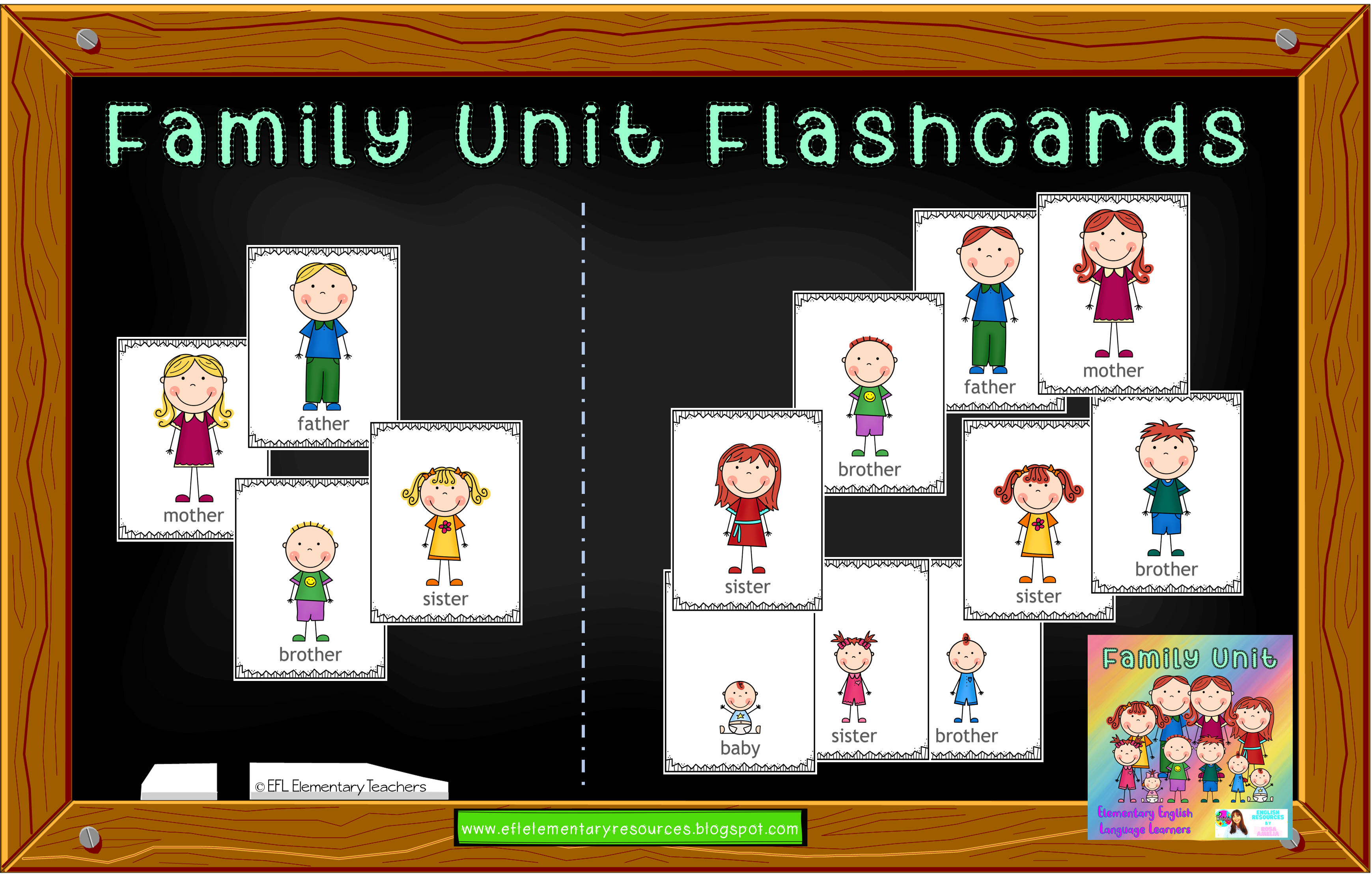
Family unit Flashcards for the Elementary English Language Learner

  This resource is included in the Family Unit for Elementary English Language Learners-Starters. Any ESL Teacher Specialist will find this material helpful.  

Click here:     https://www.teacherspayteachers.com/Product/Family-Activities-for-Elementary-ELL-1804475

ESL Teacher Specialist

Find easy-to-implement strategies for a rich learning environment with these family unit visuals.The focus is on teaching English EFL (as a Foreign Language) it can also be used for ESL/ELL/ELA.

Introduce Family Vocabulary with Flashcards

Create speaking lessons to develop fluency based on any activity proposed here. Introduce the question word:WHO? to ask about people.

Introduce the family members vocabulary.
Teacher: This is father.
This is my mother.
Students can identify family members: Who’s this?
Students: He is the brother.

question word:WHO? family unit

Develop speaking skills with this activity. Have the students understand and use this/that to introduce a family member. Hand in family members flashcards to several students to adopt that person. Assign a student to introduce them to the class: 

This is my brother. His name is Tomas.
That is my sister. Her name is Rose.


Ask questions on possessive pronouns.

introduce a family member flashcards

Give information about the family members as communication goes first. Divide the board in two and create a small family and a big family on each side of the board.
Teacher: This is a small family. It’s mother, father, brother and sister.
Teacher: This family is big. Let’s count.
Students can count the members of their family and write it down on piece of paper.
Ask questions: How many people are there in your family?
Student: five.
Ask questions: How many brothers do you have?
Student: two.

You can also assign a last name to each family. For example: This is the Blonde Family. This is the Red Family.

Give information about the family members  flashcards

Identify Family Members

Assign the sister or any other family member flashcard in the middle of the board.  Give her a name, I chose Carol. Make kind of a mind map. Talk about possession: This is Carol’s mother. Continue introducing the family member.

Ask questions: Who’s this?
Students: This is Carol’s father.
Ask questions: Who’s that?
Students: That is Carol’s brother.
Teacher: Is this Carol’s grandpa?
Students: No, it’s Carol’s father.
Understand the names of the people of the family. Students can also give names to people in Carol’s family.
 What’s Carol’s mother name?
Students: Luisa!
(write down the name on the board)

Talk about possession

Talk about the physical appearance of the family members. 

Select several flashcards of family members with different hair color.
Teacher: Look at father. What color is his hair?
Students: blond! He has blond hair.
Teacher: Who has brown hair?
Students: Mother!
Teacher: Does the sister have black or red hair?
Student: red hair!

physical appearance of the family members

Show the words big and little to introduce the brothers and sisters using the focus vocabulary.

big and little family members

Call out a name of someone in your class. They must stand up and tell everyone a fact about their family. For example: My mother’s name is Anna.’

 Jumbled names Activity

Write the word for each family member with the letters jumbled on the board. For example: emtorh (Mother) Hand in the individual flashcards to the students. Make sure that you include all students as you have a flashcard for each one. At your signal the students have to come up to the board and place their family member under the jumbled word.

Jumbled names Activity

Introduce the adjectives such as young or old to describe the family members. 

Discuss with your students why they are sorting the people into these adjectives.
Teacher: Grandmother is old.
Students: The baby is young.

Using adjectives when speaking will help studentsdescribe people using words.

adjectives such as young or old to describe the family members

Also do the adjectives tall and short to describe family members.

tall and short to describe family members

Family small cards vocabulary ESL, check the blog post:   https://eflelementaryresources.blogspot.com/2023/09/family-unit-teaching-tips-for-small.html

family flashcards for kids

Follow me at my TPT store!   https://www.teacherspayteachers.com/Store/Holistic-English-Resources-By-Rosa-Amelia