3P's lessons plans

Mostrando entradas con la etiqueta puppets. Mostrar todas las entradas

martes, 16 de junio de 2026

Was Were with Emotions Flashcards and Time Expressions Activities | Simple Past Grammar for ESL ELL

 This resource is found here: https://www.teacherspayteachers.com/Product/Was-Were-with-Emotions-and-Time-Expressions-Activities-Simple-Past-Grammar-for-16709587

Bring the Simple Past to life with this engaging set of Was/Were with Emotions and Time Expression Flashcards! Designed for elementary ESL, EFL, and ELL classrooms, these flashcards provide a hands-on approach to teaching the Simple Past of the verb to be through meaningful communication and interactive games.

Teachers will appreciate the flexibility of this resource. The flashcards can be used for acting games, sorting activities, timelines, matching games, sentence-building exercises, dice games, question-and-answer practice, memory games, classroom surveys, and storytelling activities. They are also ideal for review lessons and can easily be adapted for different proficiency levels.

Introducing Emotions in the Simple Past with Was and Were

Students can begin to describe past experiences with sentences such as "I was happy yesterday.

To support this concept, introduce emotion flashcards together with common past time expressions.

One effective teaching feature of this resource is the use of left-pointing arrows. Encourage students to notice that the arrows point to the left because the past is often represented as being "behind us" or "before now."

 Activity: Roll, Pick, and Make a Sentence!

One student rolls the printable time expression die in this resource. Another student chooses an emotion flashcard. Together, they make a sentence using the Simple Past of the verb to be based on the die.

For example: She was hungry after school.

Students develop sentence-building skills while working cooperatively with their classmates. The game can be used for whole-class instruction.

Who Was...? Who Were...?

The teacher places several emotion flashcards on the board and writes a student's name under each picture. Then, the teacher asks questions about the flashcards.

Teacher: Who was distracted in class?
Students: Pete!
Students: Pete was distracted.

Teacher: Who was sick?
Students: Eli!
Students: Eli was sick.

Teacher: Who were thirsty in class?
Students: Tim and Lili!
Students: They were thirsty.

This interactive activity helps elementary ESL, EFL, and ELL students practice the correct use of was and were with emotions, feelings, and states.

Craft Stick Puppets for Was and Were

Bring the Simple Past to life with these fun craft stick puppets! This resource includes printable templates for the words was and were, allowing teachers to create their own classroom puppets for interactive grammar practice.

During lessons, the teacher can hold up the correct puppet while asking questions or building sentences, giving students a visual cue that reinforces the grammar pattern.


Act It Out and Guess the Emotion! Emotion Charades

The teacher secretly shows one student an emotion flashcard. The student studies the picture and then acts out the emotion without speaking while the rest of the class watches carefully.

The teacher encourages students to guess by asking questions in the Simple Past: Was she angry?

Students answer using complete sentences:

Emotion Timeline

Divide the board into three columns labeled Morning, Afternoon, and Night. The teacher places an emotion flashcard in each section and guides students in describing the events using the Simple Past of the verb to be.

For example: He was embarrassed in the morning.  He was confused in the afternoon.    He was excited at night.

After modeling, ask comprehension questions: When was he embarrassed?

Students answer in complete sentences: He was embarrassed in the morning.

Once students understand the pattern, simply change the flashcards to create new timelines and encourage the class to make their own Simple Past sentences.

Sorting Emotions and Feelings

Introducing emotions by categories helps young English language learners build vocabulary. To begin this activity, the teacher presents the emotion flashcards and sort the cards into three groups on the board:  😊  Positive Emotions,    😟 Negative Emotions,   🤒 Physical Feelings

This hands-on sorting activity helps elementary ESL, EFL, and ELL students organize new vocabulary into meaningful groups.

Building Simple Past Sentences with Time Expression Flashcards

Time expression flashcards provide young English language learners with a visual cue to build complete sentences in the Simple Past. The teacher places a time expression flashcard on the board and reviews its meaning with the class. Then, the teacher adds an emotion flashcard and models a sentence using the verb to be.

For example: He was scared this morning.

After modeling, the teacher can ask questions to encourage participation: Who was scared this morning?

The teacher can easily replace the emotion or time expression flashcards to create many new combinations for speaking practice.

Correct the Wrong Sentence!

Practicing negative sentences in the Simple Past. For this activity, the teacher shows an emotion flashcard to the class and deliberately says a sentence that is not true about the picture. Students must listen carefully, identify the mistake, and correct it using a negative sentence followed by the correct affirmative sentence.

For example, the teacher shows the distracted flashcard and says: Teacher: She was sad.

Students respond: Students: She wasn't sad. She was distracted.

The teacher can continue with other flashcards:

This activity encourages students to pay close attention to the visual clues on the flashcards while practicing both affirmative and negative forms of the Simple Past of the verb to be.

Who? When? Where? – Asking Questions in the Simple Past

Encourage them to ask and answer questions about emotions and past events. For this activity, the teacher places an emotion flashcard, a time expression flashcard, and, if desired, a name card on the board. Then, the teacher writes or points to the question words:  Who?,When?,Where?

Using the flashcards as clues, the teacher asks questions such as: Who was sick?  When was Tim sick?  Where was Tim sick?

Students answer in complete Simple Past sentences: Tim was sick. Tim was sick after school. Tim was sick after school at school.

The teacher can easily change the flashcards to create new combinations and encourage students to ask the questions themselves.

If you're looking for additional ways to teach emotions and feelings to young learners, be sure to visit our Preschool Emotions and Feelings blog post! You'll discover a collection of fun, hands-on activities designed to help children recognize their emotions.

Explore engaging games, colorful flashcards, sorting activities, crafts, songs, movement activities, and classroom ideas that make learning about feelings exciting and meaningful. LINK:  https://eflpreschoolteachers.blogspot.com/2020/09/emotions-theme-for-kindergarten.html

All my covers are done with Creative Fabrica. Here is my affliate link:  https://www.creativefabrica.com/product/cute-smiles-seamless-pattern/ref/2670802/?sharedfrom=pdp

lunes, 1 de abril de 2024

Zoo animals Flashcards for Elementary English Language Learners

Find the resource(Zoo Animals Flashcards for Elementary ESL Students | Vocabulary Activities & Games)by clicking at the link:

 https://www.teacherspayteachers.com/Product/Zoo-Animals-Flashcards-for-EFL-3611842

zoo animals flashcards for elementary ESL students

Teaching the zoo unit provides a real-world context that is relevant to children's lives. The theme is across the science subjects. Many students might have been to a zoo and it will be fun to know their experiences.

Zoo Mind Map

Write the word zoo on the board and ask students the name of zoo animals they know. Start putting the zoo animal vocabulary flashcards on the board as they say the word as in a mind map.

Teacher: There is a bear in the zoo.

Have students make similar sentences.

flashcards examples for students

Model demonstrative sentences using the ESL zoo animals for describing.

Teacher: This is an elephant. It’s gray.
Students: This is a lion. It’s brown.

elementary zoo flashcards

Identify the Animal with this zoo animal activity

Place the flashcards on the board and write a number next to it. Ask questions: What is number 2?
Students: It’s a monkey!
Teacher: What color is number three?
Students: orange!
Teacher: is number five an elephant?
Students: Yes, it is.
Teacher: is number two a bear?
Students: No, it isn’t. It’s a, monkey.

ESL animals lesson

Movement Game for the zoo animal vocabulary

 Run to the card. Place all the flashcards on the board in random order and disorganized. Divide the class into two or more teams. Call out an animal. The first student to touch with a pencil or pen the correct one wins a point for the team.

zoo animal vocabulary for kids

Listen and stand up! 

Distribute all the flashcards to all the students, you can even give out more than one. Call out an animal and the student who has it must stand up and say the word. That student 
can´t sit down again. Play until there is one student left, who is the winner.

Animals come in groups and use it for reviewing plurals.  Write a number next to each flashcard. Ask questions: Look at flashcard number 2. What are they?
Students: They’re kangaroos!
Look at flashcard number 3. Are they lions?
Students: Yes, they are.
Look at flashcard number 4. Are they zebras?
Students: No, they aren’t.

zoo animals activities ESL

Play Yes or No!

Print and have ready the puppets. One per group or for each child. Students can also make their own puppets by gluing the cards onto wooden sticks of your preference.

ESL zoo animal flashcards

You can ask questions for any zoo animals flash card: Is this a penguin?

 and the students will show the corresponding card puppet and say: 

Yes, it is !

zoo animals flash cards

As a variation, say statements like: This is a green penguin!

Use the puppets with any unit or theme.

Finally, here's the video: 


These activities are ideal for: elementary English language learners.beginner ESL students, vocabulary lessons, speaking practice, classroom centers.

This giraffe family resource gives teachers a clear, visual, and engaging way to introduce family vocabulary while supporting speaking, listening, and early sentence building for young EFL learners, included in the full zoo pack. Go to the blog post:

Follow me at my TPT store!  Get notifications when new resources are listed.

https://www.teacherspayteachers.com/Store/Holistic-English-Resources-By-Rosa-Amelia

viernes, 6 de noviembre de 2020

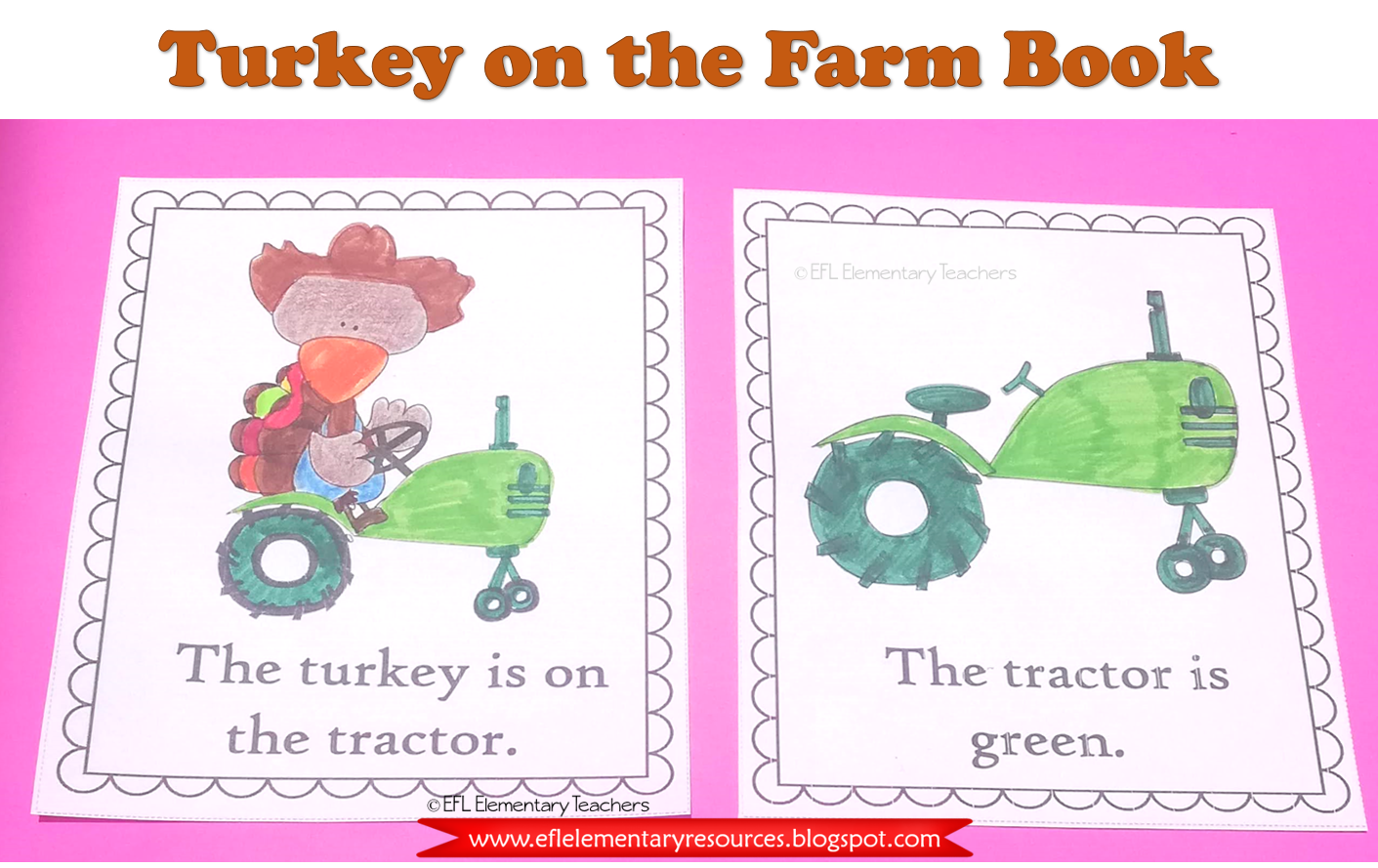
Thanksgiving Printable Book for ESL: Turkey on the Farm

 Adding a new Thanksgiving resource to all the other that are already here on the blog. Check them at the label section on the right column.

LINK to the resource:   https://www.teacherspayteachers.com/Product/Thanksgiving-Printable-Book-for-ESL-6213262

Thanksgiving resource

Print the pages of the book.
                                                             
basic english reading for elementary

 Students can make individual books or group books. Students will color each page as they read the sentences.
There is a set of a turkey surrounded by several objects and pages describing each item. You an put them together.  I would make the students color the separate items first and then look them up in the turkey picture and color accordingly.
Another example:
       The pages are meant to review vocabulary from the farm unit that might have previously taught.
the last set of turkey and vocabulary pages.
                                       Put all the sets together and bind the pages of the book.
Prepare all the toilet paper roll puppets. You can also do craft sticks or flannel board cutouts for storytelling.
                                       You can also practice prepositions. 
Teacher: Put the turkey in front of the barn.
Teacher: What color is the barn ?
Students: It's read and white.
More examples for practicing prepositions.
Students can say positional sentences to other students to find the items and place them in the correct postion.
Student: The turkey is in front of the barn.
You can place the puppets in any position and ask questions.
Teacher: Where is the turkey'
Students: It is between the basket and the chicken.
Follow me!


domingo, 13 de octubre de 2019

Halloween Activities for the ESL student

Another Halloween again! I prepared this resource with many things. Hope you like it. 
how to teach Halloween to esl students

Let’s start with Halloween Flashcards!

Halloween Flashcards


 Picture Dictionary. Hand in the 3 pages for making the picture dictionary. It is a good idea to do this in groups. This is a cut and paste activity.

Picture Dictionary Halloween

I love tracing cards. It is a spelling activity that can be done using the clear plastic sheet. Just as some native language students learn to trace words in Preschool some ESL learners benefits from tracing.

tracing cards Halloween

I made another set of tracing cards that can work as coloring cards. Practice coloring the body parts and/or the clothes.

I made a smaller version of the tracing cards to create an accordion book.

First, I glued one card onto another.


Then, I folded all the cards into an accordion.

I traced the cover onto cardboard to make the other part of the book. I glued the first page onto the cover and the last one onto the cardboard.

Just a worksheet to place all the words in ABC order.


Spelling Bingo is always a fun game to play. Use the small cards or the Big Flashcards to call the Bingo words. Students just write a playing word in each part of the spinner. They have to cross out the word that is being called if they have it.


If Spelling Bingo is not enough. Try Spelling Scrabble. I added the Scrabble letters. I printed them onto Halloween colored paper, I chose orange and purple. I did my example using the puppets, you can use any of the small cards in the resource.


I also made worksheets with all the Halloween Characters without the face parts and for the students to color the clothes items.


Teacher: This is Dracula. He has green eyes, a small nose and funny mouth
Students draw as indicated.
You can also dictate how he is dressed or have them color the clothes and then describe his clothes.
Students: Dracula is wearing a black and red cape, gray pants and brown shoes.

I made all the characters into puppets using toilet paper rolls. Here are just a few and made a haunted house, it comes in two pages which you will have to glue to make a big one. I printed mine onto orange cardboard and colored the door, the windows and roof to review parts of the house.
Teacher: What color is the door?
Students: It’s brown!
Use the puppets to review the words.
Teacher: Who is he?
Students: He is the Mummy!
Teacher: Who is she?
Students: She is the Witch!


I also used the puppets to do prepositions practice.
Teacher: Where is the Devil?
Students: She is in front of the Haunted House!


 Teacher: Where is Frankenstein?
Students: He is behind the Haunted House!


Teacher: Where is the Witch?

Students: She is in the Haunted House!


Or have the students write about where the characters are.


A game board for those minutes of free play!


I taped an opened clip behind each game piece to make it stand as a marker.

Please follow me! Leave your comments. Ask me anything related to the product.