3P's lessons plans

martes, 6 de febrero de 2024

Food unit Flashcards for Elementary English Language Starters

 This resource (Food Unit Flashcards — ESL/EFL Printable Cards for Elementary Food Vocabulary) is part of the complte food pack that can be used by 1st and 2nd grade English Teacher.

LINK: https://www.teacherspayteachers.com/Product/Food-unit-for-Elementary-English-Language-Learners-Starters-11035412

1st and 2nd grade English Teacher.

Use the food and drinks unit flashcards as an aid for your visual learners. They provide a visual representation of the most common food items for this range of age and level of your students. The flashcards are to capture the attention of your students.They will associate the image and the word on each card. Perfect for visually oriented students to support the comprehension and memory of the new vocabulary.

Understand your learner and adapt the activities to your teaching style. Present the new common food unit vocabulary using the nice illustrations.

Ask questions for countable nouns: What’s this?

Students: It’s a hotdog.
Ask questions for uncountable nouns: What’s this?
Students: It’s cereal. Stress the difference!
Have the students classify the food items flashcards into countable or uncountable nouns.

food unit flashcards as a visual aid.

Ask questions about preferences, after placing several flashcards on the board, using food words in simple questions and answers : What would you like?
Student 1: I would like soup!
Student 2: I would like milk!

food and drinks flashcards

Practice speaking. Have the students ask for food using the expression: Can I have soup, please?
Teacher picks the soup flashcard and hands it in to the student saying: here you are.

Ask questions about people: What are Tima and Mia eating?

Students: They are eating pizza.
What is Nick cooking?
Students: Chicken!
What does Fred have?
Students: chicken and fries.

Food unit flashcards ESL — printable food vocabulary cards for elementary English learners

Ask students about their likes using the present simple affirmative or negative.
Student 1: I like bread and orange juice.
Students 12: I like fries and lemonade. 

likes using the present simple affirmative or negative flashcards

 What about food that they don’t like. Same thing, have them pick up the food flashcards that will express their preference.
Student1: I don’t like donuts and meat.
Student 2: I don’t like soup and eggs.

Food flashcards ESL

Have the students select the food that they would have for breakfast or lunch and place it under the word.

Play an easy game. Say the color of a food item and the students have to name it: white and yellow!
Students: egg!

food item flashcards

Model some sentences with positive and negative sentence using the flashcards:
Student 1: I have a sandwich.
Student 2: I don’t have a sandwich. I have a hamburger.

ESL food flashcards

Have the children create a classroom menu using the flashcards. Tell them that as a class they will put up a menu. Then, ask: What’s on the menu to eat?
Student: pizza! Fries! Hamburger, chicken! Hotdog! Salad
Teacher: What’s on the menu to drink?
Student: milk, soda, lemonade, orange juice.

This is an idea to extend the lesson. Students can then make their own menu on their notebooks or paper, using the words they know or any other food items that they want to include. Then do a show and tell of all the menu.

food unit menu with flashcards

When to Use These Flashcards
• Vocabulary introduction or review  
• Small group practice  
• Partner speaking drills  
• Morning routine or warm-up  
• ESL centers or station rotations

These food unit flashcards give ESL/EFL students multiple exposures to essential food vocabulary through visuals and language practice, making abstract words meaningful and more likely to stick in long-term memory.

With this pizza-themed numbers set, you don’t need to design complicated worksheets or gather tons of materials. The resource is ready to go and is included in the complete food unit. Go to this blog post:   https://eflelementaryresources.blogspot.com/2025/05/using-pizza-themed-resources-to-teach.html


Click here: www.eflpreschoolteachers.blogspot.com


martes, 16 de enero de 2024

Pets Unit Books for Elementary ELL

This resource is part of the pets unit for Elementary English Languge learners-Starters to provide studenst with more exposure to the language.    LINK: https://www.teacherspayteachers.com/Product/Pets-Unit-for-Elementary-ELL-Starters-10780015

Interventionist for english teachers

There are two printable pets unit books to wrap up this unit. They will incorporate the language skills of reading and writing for Elementary ESL/ELL learners. As a teacher you are unique and your students as well. Adapt the activity according to your learners to practise animal vocabulary, comprehension, and simple sentences.

Book 1: Students can color as they wish or you can dictate the colors of each animal on the template and the place where they belong as a listening part of this activity. Then, they will cut the animals and glue them in the corresponding spot. There is a li8ned page for the students to write the next to finish the book.

two printable books pets unit

BOOK 2:  This is a group book, each student will color a page and then assemble and read together and take home to read with the parents.

group book pets unit

When to Use Pet Booklets
• During pets or animal themed units  
• As part of reading centres  
• For paired or small group work  
• As homework reinforcement  
• During ESL morning routines

Printable pets unit worksheets for elementary ESL/ELL learners — practice pet vocabulary, reading, writing, and speaking through fun ESL activities. They are part of the complete pets unit pack:   https://eflelementaryresources.blogspot.com/2024/01/pets-unit-worksheets-for-elementary-ell.html

This resource is part of a Bundle: 

https://www.teacherspayteachers.com/Product/Elementary-English-Language-learners-teaching-Units-Starters-BUNDLE-11215540

jueves, 11 de enero de 2024

Pets Unit Games for Elementary ELL

 This resource is included in the Pets Unit for Elementary ELL -Starters. Use these to give your K-2 English students a variety of activities to engage them.

LINK: https://www.teacherspayteachers.com/Product/Pets-Unit-for-Elementary-ELL-Starters-10780015

K-2 English students

The games will boost your students’ confidence in their English language skills. They will participate with knowledge of the language and take risks at playing with their peers. Games provide a place to motivate speaking expanding your students' linguistic competence.

The pet unit board game can be adapted for the different levels of English that you have in class. Make your own rules for the game or even better have the students make new ones to make it more challenging for the more proficient students.

Print the board, cut and glue to assemble one bigger game. Glue the tips of the game board markers. There are four, so this is a game for mainly 4 students. The pet shop template is for students to place the cards they get when playing. The winner is the one with the most pets in their shops. Students can play by just recognizing the pet they land on and get the corresponding card to place in their shop. As they get more advanced, make more difficult gramma sentences, such as: I want an orange cat for my pet shop.

pet unit board game

Playing this picture and word domino is great to use as a social interaction activity to promote socialization between your students.  It will be a matching picture and then word and so on. If you need bigger tiles let me know. I made them small in order for students to take them even outdoors or to play on their own.

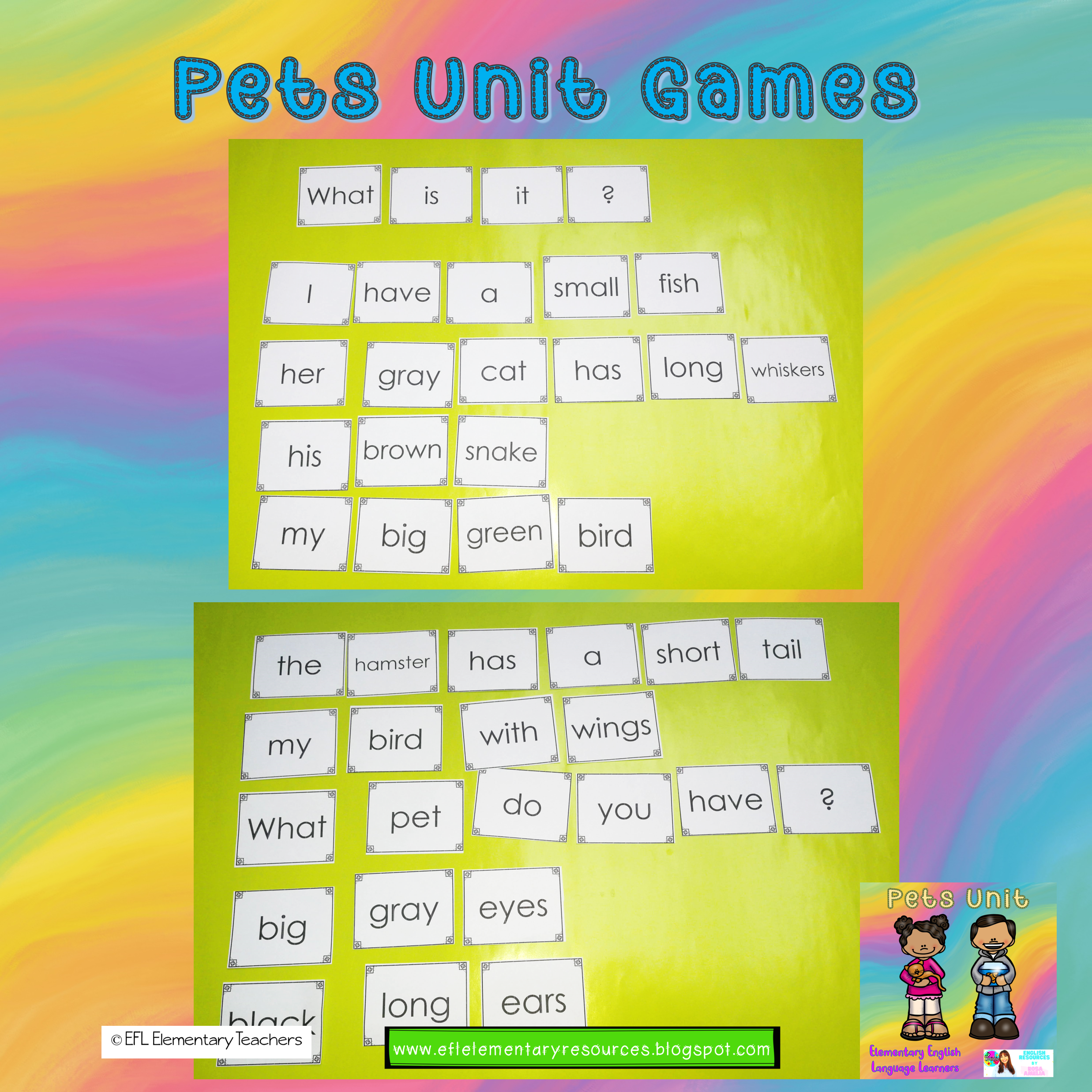
Jumbled sentences games will reinforce the students with the correct understanding of the order of words in a sentence. This works towards proper grammar and syntax rules. Students’ ca moves the cards to make larger sentences or just make phrases. They can even write them down on their notebooks afterwards.

The sentence association game is great for language production as the students have to read the sentences and find the corresponding picture. They might find two pictures for one sentence and use their ability to pick the correct one. As your teaching context is unique, adapt this game as a reading activity or a listening/speaking one in which one student reads the sentence and the others find the corresponding card with the picture.

There is a set of small cards with pictures and words. It will help students memorize the new vocabulary. Use them for writing activities if you wish.

Include spelling activities for vocabulary development. This kind of activities helps into learning and remembering the new words.

After the students write the words using the cards, they can also write those on their notebooks.


 I used play Spelling Bingo a lot with my students. They really loved it. Just hand in a spelling bingo pet template to each student or group of students, so they know that these are spelling words playing. They will write five pet words on the template.

Call the words using the cards from any of the games above.


Made a guess what? Instead of a guess who? game. Give each pair of students a template with all the pets. I would suggest that you place them on a clear plastic sheet for them to write on the card and then erase easily for future use.

The students will ask each other questions bout the animal that one student selected for the other to guess: Is it green? Does it have big eyes? Is it a frog?

The dog and prepositions ESL activity — printable worksheets and hands-on games to teach prepositions of place with a dog theme. Go to this blog post:

https://eflelementaryresources.blogspot.com/2024/04/the-dog-and-prepositions-for-elementary.html 


Check my blog for Kindergarten English Language Learners and find more resources on this unit. CLICK: https://eflpreschoolteachers.blogspot.com/2021/05/pets-unit-flashcards-for-kindergarten.html

lunes, 8 de enero de 2024

Pets Unit Worksheets for Elementary ELL

This resource is part of the pets unit for Elementary English Languge learners-Starters. ENL teacher can find the material useful.    LINK: https://www.teacherspayteachers.com/Product/Pets-Unit-for-Elementary-ELL-Starters-10780015

ENL teacher

 Here are the Printable pets unit worksheets for elementary ESL/ELL learners  to practice pet vocabulary, reading, writing, and speaking through fun ESL activities. The worksheets were designed with lovely visuals and fun tasks. They will capture your student’s attention and enjoy working on them.

Here is a video with all the worksheets in the resource.


This word search helps beginners review pet vocabulary while building spelling skills.

This worksheet helps students practice beginning sounds and pet vocabulary by writing and coloring words that match each letter.

These worksheets help beginners review color words and pet vocabulary through simple drawing and coloring.

Students draw and label their favorite pet, identifying body parts such as ears, tail, legs, and whiskers. They then write a short descriptive sentence using colors and simple adjectives. This activity supports vocabulary development and sentence writing.

Students draw the pet they have at home and add their picture to a class graph. Together, the class compares how many students have dogs, cats, other pets, or no pets. This activity builds early graphing skills.

Students create a pet shop by folding, labeling, and gluing the animals onto a shoebox, then adding a store sign. All this, after completing the pet word on the worksheet.

Learning to use adjectives to describe pets will contribute to the student’s vocabulary expansion. Students cut and paste the pet pictures to sort them by key features: long or short ears, long or short tails, and animals with two or four legs.

Students follow step-by-step directions to create a pet shop scene. They listen and color the pets as the teacher describes them, cut out the animals, and glue them behind the shop window using construction paper. Students finish by writing a short description of their pet shop, combining listening, fine motor skills, and simple sentence writing.

Students listen and color the parts of the pets’ bodies as directed, then answer simple questions about the colors they used. This activity reinforces body-part vocabulary.

Students practice numbers 1 to 20 by coloring the birds according to number-color clues and then writing the answers in complete sentences. This two-step activity reinforces number recognition, color words.

Explore the complete Numbers 1 to 20 resource included in the complete pet pack. Check the blog post: https://eflelementaryresources.blogspot.com/2024/08/pets-unit-numbers-1-to-20-for.html

These worksheets help beginners practice numbers 1–20 by matching, ordering, and writing missing numbers on their notebooks.

Students read simple sentences and color the pictures to match the descriptions.

Students cut and paste the animals into the correct places where they live, such as a cage, tank, or bed. This hands-on activity helps learners practice pet vocabulary, early categorization skills, and following simple directions while strengthening fine motor skills.

Students read simple sentences and place or draw the animals in the correct rooms of the house. This activity helps learners practice basic prepositions of place, house vocabulary, and sentence comprehension through a hands-on, visual task that is easy for teachers to model and assess.

This first worksheet helps beginners practice prepositions of place and house room vocabulary through clear pictures and simple sentence frames. The second Worksheet where students answer basic comprehension questions about pets.

Students read and color the pictures, then rewrite the sentences and create their own questions using Who…? This activity helps learners practice early question formation.

After matching the pets to the correct children, students write the missing words to complete each sentence. This activity reinforces the sentence pattern “He/She has a.

This worksheet helps beginner learners describe pets using simple sentences and colors. Students read, write, and draw, reinforcing vocabulary, sentence structure, and comprehension in a fun, hands-on way.

Be fancy and provide each student with a clipboard, pencil, and the questionnaire worksheet. After the writing all the answers, gather the students in different groups to share their findings and discuss the results.

Students read short, meaningful sentences and show understanding by drawing, coloring, and completing the pictures, which lowers anxiety and builds confidence.

This worksheet helps beginners practice spelling by completing simple animal words and matching them to pictures.

These worksheets help beginners practice pet vocabulary and simple grammar through clear visuals, repetition, and hands-on writing, making language learning easy, engaging, and confidence-building.

Perfect for early learners, these worksheets combine writing, vocabulary, and visual support to develop confidence in describing pets.

Practice the Numbers 1 to 20 within the Pets Unit. Go to the blog post:   https://eflelementaryresources.blogspot.com/2024/08/pets-unit-numbers-1-to-20-for.html

Check at the Pets Bundle, here:   https://www.teacherspayteachers.com/Product/Pets-Unit-BUNDLE-for-Kindergarten-and-Elementary-ESL-6951779


I’m sharing a collection of all the links to my resources designed specifically for teaching English to young learners. Whether you’re looking for interactive worksheets, thematic units, or creative activities, you’ll find valuable tools to support your classroom needs.

Go to my Linktree and subscribe