miércoles, 30 de enero de 2019
Possessive pronouns, nouns, adjectives, form, questions for Elementary ESL
LINK to the resource on a unit to express possession:
Watch the video of the resource:
I always use flashcards to introduce the grammar
point. I wish I had all these resources when I was teaching at a school 30
years ago. I had to draw mine or use magazine cutouts. Well, time flies and
here we are.
Use
the big flashcards to place the on
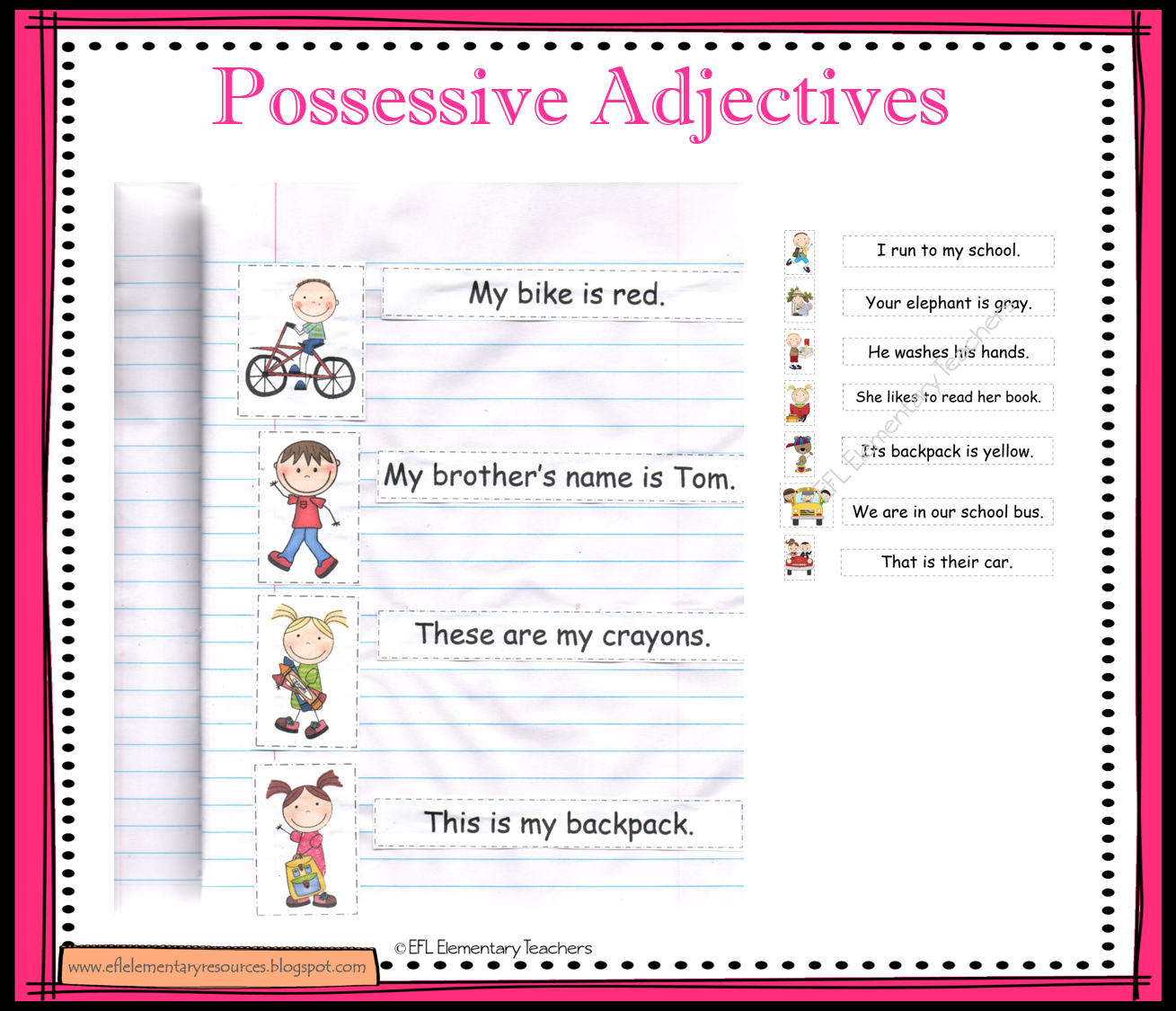
the board as mine.They will give the use of the possessive adjectives in context.
Teacher: I run to my school.
Underline
and point out I and My. Continue
with the rest of cards.
I
also made some cutouts to make sentences.
Teacher: My favorite color is pink.
Students: Our favorite color is brown.

Play is also a teaching tool to review this grammar
point giving student access to communication and creation.
Game 1: Play sentence association.
Display all the cards on a table and have the
students place a sentence next to the picture card just as your board example.
And do even more, give them a blank rectangle and
students write a sentence using a possessive adjective.
Game 2: Match the
subject pronoun to the adjective pronouns.
Game 3. Make possessive adjectives sentences.
Cut all the words from each sentence and have the students build the sentence
and match to the picture cards. I glued each word onto fun foam to make their
studier.
Game 4. Sort the
sentences into Possessive
adjectives, form, questions.
Or sort them using
envelopes. I placed a big clip on the back of each envelope for standing
purpose. I also glued the super children characters on each envelope.
Game 5. Feed the
zebra. I cut all the words from each sentence of the sentence association game.
I grabbed an empty soda plastic bottle and glued the zebra printable. I managed
to cut the mouth out. Students feed the zebra by reading each word.
I made a short video.
On the notebook. It is
always fun to cut and glue.
There is a bundle for the Adjectives for teaching ESL Elementary students. Check it out.
lunes, 21 de enero de 2019
Numbers 1 to 100 for ESL Learners- part 2
This is the second part for numbers 1 to 100. It is all in one resource here:
Watch the video of the complete resource:

More Classroom-Ready Activities & Ideas to Teach Numbers 1–100 in ESL/EFL. This is Part 2 of our number series — giving you even more ways to help elementary English language learners (ELLs) practice numbers from 1 to 100 in meaningful ways. These activities build fluency, confidence, and number sense through games, speaking, listening, and interaction.
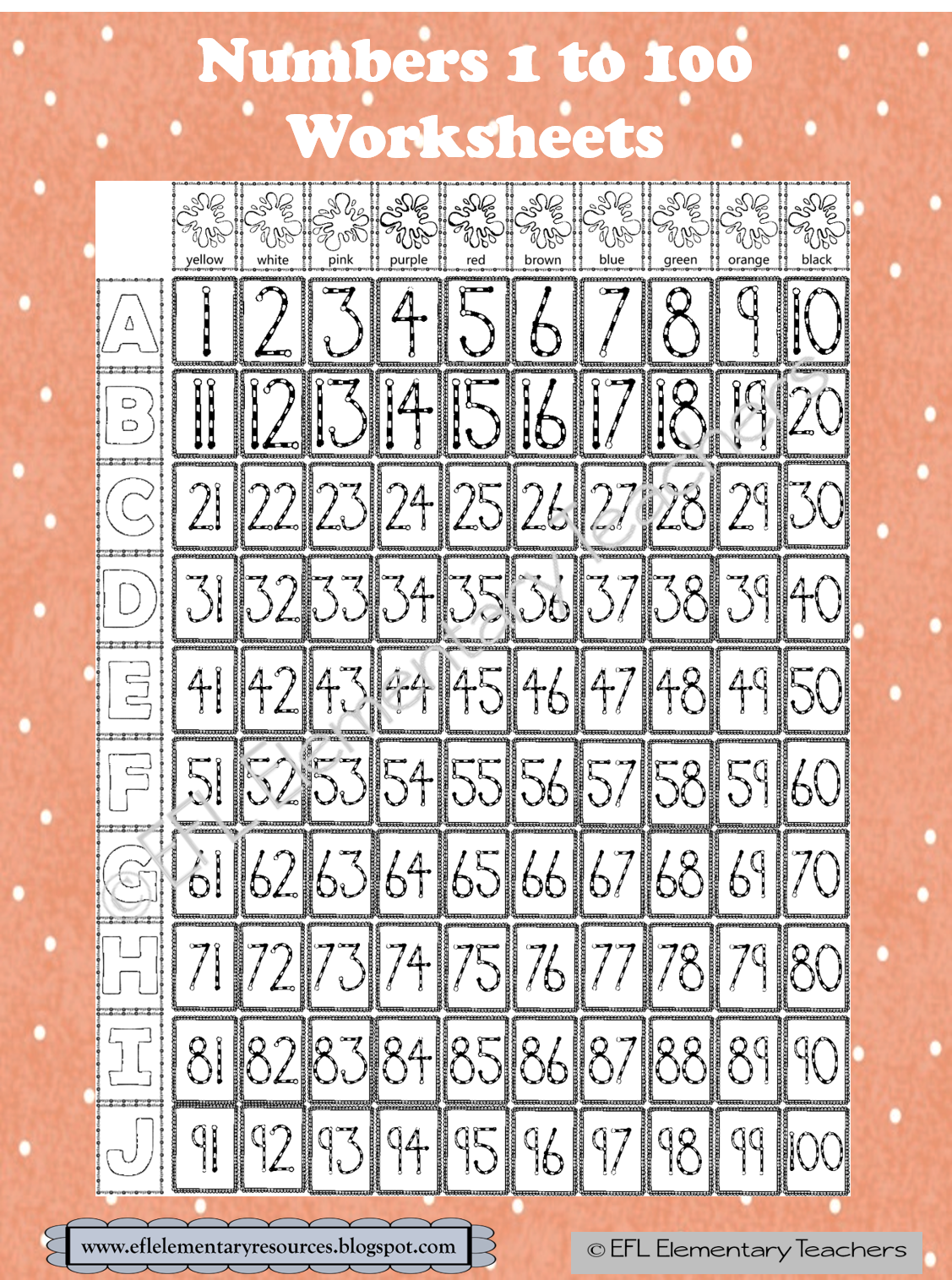
100s chart with Number, Colors and
Letters flashcards. I saw a similar idea on an old book and
thought I could make one that can be used in the classroom and a small version
for students to play in small groups. Place on the board all the colors
flashcards horizontally and the letters cards vertically and fill in with the
numbers flashcards.
Teacher: F ! blue!
Students: 57!
Teacher: 88!
Students: I! green !
Make
more examples for the class to guess. Then students in small groups can play
with their printable version.
Use
the Number chart sheet printable. Give students instructions for coloring some
numbers.
Teacher: Number 91 is red.
I
also have a the colored worksheet that you can use multiple times for speaking
activities . Have the students read aloud the numbers in chorus as you say the
row.
Teacher: Row F!
Students: 51,52,5,3,54,55,56,57,58,59,60!
Teacher: RED!
Students: 5,15,25,35,45,55,65,75,85,95!
Use the Ipad
printable for writing.I placed the printable into a clear sheet and used
white board markers for writing. All these materials can be used for all your
themes.
I have this round puncher that I usually use to punch
out colored cardboard pieces left from other projects. I made a matching game using them.
Give the students the blank squares and a numeral card.
They have to write that number in words and keep it but hand in the number
card. Mix up the number cards and hand
in the students a different number card. At your signal students have to stand
up and walk around looking for a match of their number card and a word card
that they wrote. When they have found a match they say MATCH! Go over and verify, take away both cards of the match and
have them continue playing.
Tell the students that they are going on a fast counting investigation. Give each group
a classroom item card and have them count how many of that item are there in
the classroom.
Group 1. There are 25
backpacks.

I found the idea of a similar game at Mailbox.com, I thought that it is a fun speaking game and
gave it a twist. I added children on motorcycles and a road, along with Go and
stop sign, not missing the numbers cards 1 to 100. Get two lunch bags and glue
the stop and go on each bag. Separate the class into small groups and hand each
group a set of bags with the numbers cards in each bag and the game pieces.
There are 5 children on their motorcycles. Each student picks a character.
Student 1 picks a card from the Go bag and a card from the STOP bag. That
students says the numbers from the go to the stop numbers. If the student 1
says all the numbers, he moves his character one line along the road and sets
aside the number cards. If the student does not say the number correctly, then
the character cannot move.
Place all the numbers in a bag. Grab a number card and
say it. Have the students write 3 more consecutives numbers and read the
sequence aloud.
The small number
cards can be used to express number sense in the target language. I made a
printable format to play with the numbers finding consecutive numbers, the
numbers before and the numbers that go after a specific one.
I
made this Monster eats box for my Alphabet blog post. I had it standing around
the studio and used it with the Number cards.
Teacher: Find number 55. The monster is eating number 55!
Use
the small number cards to review prepositions. I printed a big 100 number and
placed a clip behind it so it can stand. I also placed small clips behind the
small cards.
Teacher: Number 50 is on Number 100.
Teacher: Number 55 is behind Number 100.
Teacher: Number 57 is in front of Number 100.
There are many ways to have the students practice writing.
Students can have their own set of scrabble letters and
write the word for each Number flashcard.
I love this scrabble game. Students can play at their own pace. Students can make their own rules and have fun while writing number words.
Just three worksheets
to join this theme. I have seen so many teachers using notebooks and I
remembered me using them a lot. I would tear down a worksheet and make more
activities on the notebooks. I gave my own worksheets a try.
And I got inspired remembering what I used to do years
ago. Students can copy the numbers from the board or from the flashcards.
Dictation is a good listening exercise.
Please follow me and leave your comments!
viernes, 18 de enero de 2019
Numbers 1 to 100 for ESL Learners
Fun & Practical Activities to Teach English Numbers (1–100). This is the link to this resource: https://www.teacherspayteachers.com/Product/Numbers-1-to-100-for-ESL-Learners-4316217
Watch the video of the complete resource:
Help your elementary English language learners (ELLs) master numbers from 1 to 100 with meaningful, enjoyable activities! This post shares classroom-ready ideas for teaching number vocabulary — ideal for ESL/EFL learners, newcomers, and young students with early English skills.
Why Numbers 1–100 Matter in ESL
Numbers are everywhere — schedules, prices, ages, dates, classroom routines, and games. Teaching numbers up to 100 helps students:
✔ Ask and answer How old are you?
✔ Tell the date and time
✔ Count objects
✔ Read number words
✔ Use numbers in real life
Introducing numbers with visuals, movement, and conversation helps students internalize language instead of memorizing lists.
Number Cards & Flashcards
Let’s start with the Number flashcards that I made with the words. Use printed number cards to introduce vocabulary from 1–20, then extend to 100. Point to each card and say the number together.
Teacher Tip:
Ask students to identify missing numbers in a sequence: “What comes after 37?”
And flashcards without words.
Number Line Practice. Create a large floor number line using tape. Students jump to the correct number you call — great for kinesthetic learners!
Questions to ask aloud: “Jump to 15.”,“Who can find 62?”,“Which number is next?”
Use the fly swatter to play with the flashcards. or do this Speaking activity. Hand
in a number flashcard to each student. At your signal have them order
themselves. Then, have them take a step and say their number on the flashcard.
Student: I am number 85.
Counting Numbers by 10s.
Place all the flashcards on the board. Say all the numbers and have the
students notice what is common to almost all the numbers. TY-ending. Say a number and have a student come up front and touch
the number and say the word.
Teacher: sixty, eighty, twenty!
Have
the students write the numbers on their notebooks as they see on board.
Dictate
numbers: 60, 40, 20, 50, 90, 10, 20,70, 100
Have the students learn about equations. Place the number 80 flashcard on the board, the add
symbol, then number 10 flashcard and the equal symbol and the ninety flashcard.
Read the equation. Make more examples for the students to read. They can also
make more examples on their notebooks.

Place
the following pair of flashcards on
the board. Point to each pair and stress the difference between each.
Teacher: four-teen and for-ty
Say
the teen number and the students the 10s number.
Teacher: sixteen!
Students: sixty!
Numbers and prepositions.
Place 9 random flashcards on the board and ask questions.
Teacher: What number is on 10?
Students: 78
Teacher: What number is under 10?
Students: 63
Teacher: What numbers are next to 10?
Students: 26 and 32
100s chart with Number, Colors and
Letters flashcards. I saw a similar idea on an old book and
thought I could make one that can be used in the classroom and a small version
for students to play in small groups. Place all the colors flashcards
horizontally and the letters cards vertically and fill in with the numbers
flashcards.
Teacher: F ! blue!
Students: 57!
Teacher: 88!
Place
the people flashcards on the board.
Ask questions.
Teacher: Who is number 46?
Students: Erick!
Teacher: Rick!
Students: 29!
Teacher: Is Mandy number 54 or 24?
Review There is structure.
Place all the crayons flashcards on the board in random order.
Teacher: There is a yellow crayon! What number is it?
Students: It is number 24.
Have
a volunteer student model the sentences and the class will answer.
This blog post is to add up to my last post about numbers 1 to 20. Link: https://eflelementaryresources.blogspot.com/2018/02/teaching-numbers-1-to-20-to-esl-ellsefl.html
domingo, 28 de octubre de 2018
Insects Unit for Elementary ESL- part 2.
This is part 2 for the Insect unit. Here is the link to the product.
This second part of the Insects ESL Unit includes speaking activities, prepositions practice, math vocabulary games, storytelling ideas, and worksheets that help students expand their vocabulary and build complete sentences about insects.
Countring Game
How many bugs are there? I
made some cutouts to be used as a diorama or permanent exhibit for
speaking opportunities. I placed a clip behind each animal to make a diorama on
a desk.
Teacher: Look ! a bee hive! How many bees are there in front
of the bee hive ?
Student: There are four!
Teacher: How many bees are there behind the bee hive ?
Student: There are three!
Teacher: How many bees are there in the bee hive ?
Student: There are seven!
Or use the cutouts on the board.
Teacher: What are they?
Student: They are spiders.
Teacher: What color are the spiders?
Student: They are brown spiders.
Teacher: How many spiders are there on the spider web?
Student: There are five blue spiders! There are five brown
spiders!
Or
students can make their own posters and write their paragraphs!
Prepositions of Place Activity
I made these small cards for several games. Review prepositions with the students. Students
listen to the directions and place them where they belong.
Teacher: There is an ant on the chair. There is a bee
under the chair. There is a spider behind the chair. There is a ladybug in
front of the chair.
Color Review Game
Teacher: What color is the worm?
Students: It is purple!
If
they colored as they wished the bugs. Have them make groups of the same color
bug.
Teacher: Who has blue butterfly?
Stand up and make a group.
Continue
with all the cards and count how many students are in the same color bug group.
Storytelling with a Flannel Board
I had this book from my kids. You can read the book and
then use the flannel board to retell the story using the cutouts in the product.
I made mine out of floor cloth for mopping. I added Velcro to all the pieces,
it stays on the flannel board and does not come down. It is easy to take off
and relocate. If you want the story to retell it, request it: ei98srl@gmail.com
Watch the videos!
Math Vocabulary Game
Math
vocabulary has to be introduced in all units to increase language
production in this area. Use the cards to play games. Give a group of students
the butterflies, another the number words and the next group the number cards.
At your signal have them walk around and find the match of the three cards. The
first three students to do so calls stop! And hands in the cards to you. Place
them on the board.
This activity is part of a larger unit. Part 1: Insects Unit for Elementary ESL, here: https://eflelementaryresources.blogspot.com/2018/10/insects-unit-for-elementary-esl.html
This resource is part of a complete BUNDLE: https://www.teacherspayteachers.com/Product/Insects-or-Bugs-Unit-for-ESL-BUNDLE-6571592
Suscribirse a:
Comentarios (Atom)