

Seasons and nature activities help elementary ESL students connect vocabulary with the world around them. Using trees, animals, and seasonal visuals makes it easier for students to observe changes in nature while practicing speaking, sorting, spelling, and prepositions.

Introduce Seasons with Tree Flashcards
Start with the trees flashcards in different seasons.
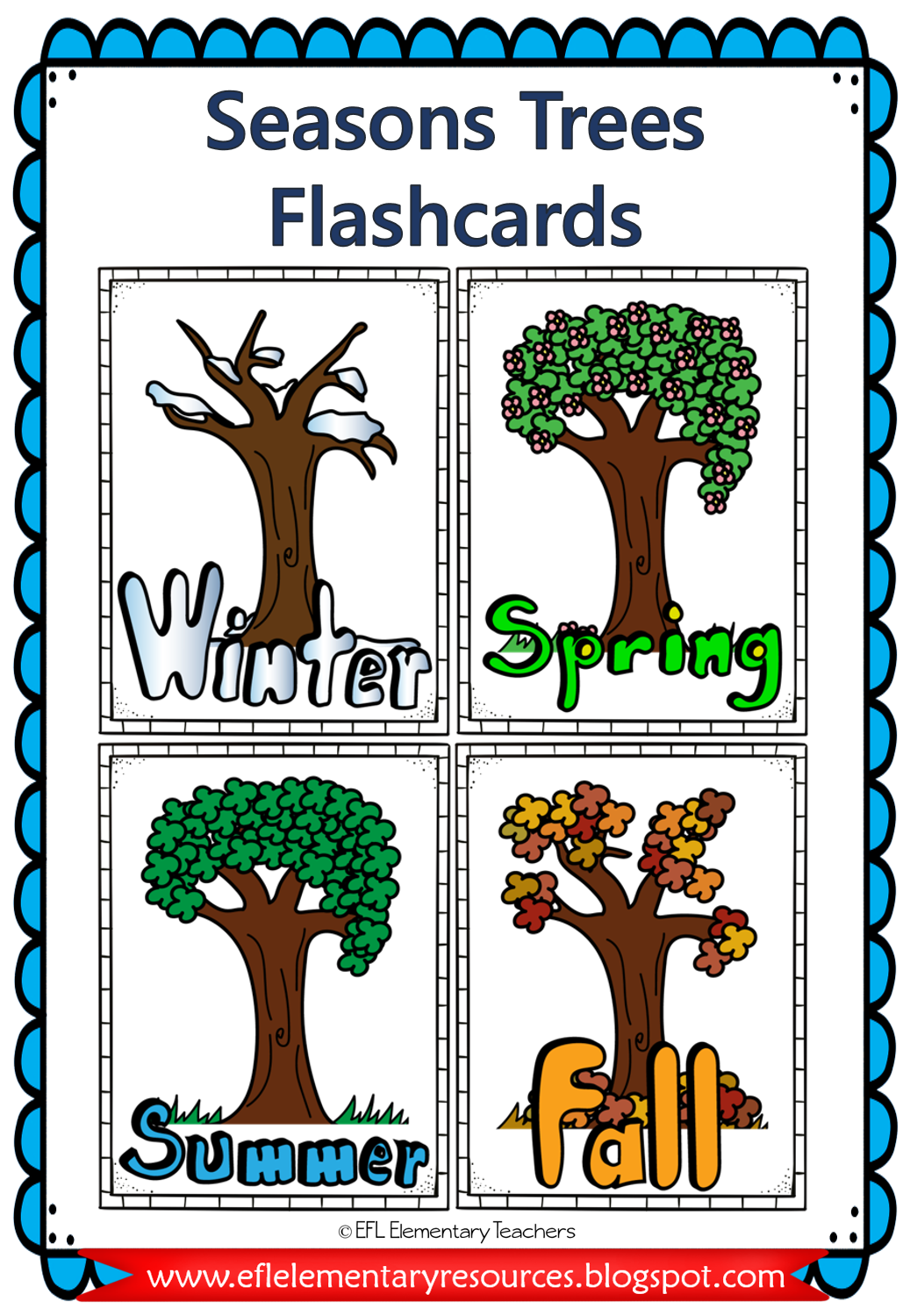
Sort Trees by Season
Place each Season Flashcard on the board
and have the students name them. Then, have the students sort the trees into
each season. Have them notice how they change with each season.
Teacher: What season is
this ?
Students: It’s Winter!
Teacher: look at the
tree. What happened with the leaves?
Students: There are no
leaves!

And again
the worksheet to sort the trees.

Use a Tree Craft for Speaking Practice
Cut the trees from the worksheet and make a small craft. I cut the toilet paper tubes into smaller rolls. Then, cut two slits on each one and place the tree. Ask questions:
Teacher: What season is this ?
Students: It's Winter.
Teacher: Dos the tree have leaves ?
Students: No, it doesn't.

Introduce the Nature vocabulary using the
flashcards.

Introduce Nature Vocabulary, video!
Sort Nature Vocabulary by Season
Then, have the students sort them into
each Season.
Teacher: What is this ?
Students: It’s a polar
bear.
Teacher: What season do
you see a polar bear ?
Students: In the Winter!

And another
worksheet to sort the nature vocabulary.

Roll
,read and write (Spelling game).
I saw this game on the mailbox.com. I gave it a twist. Distribute a die and the
templates to each group. Hand in the nature cards template and the die
template. Explain that each number represented on the die stands for the number
of letters in a word. In each group, the students take turns to roll the die
and choose a card from the template that has the corresponding number of
letters that is on the die rolled. The student has to make a check mark on that
word. The student reads the card to the group and they have to write the word
under the corresponding column. Each word can be written only once.

Watch the videos on how to play.
Seasons and Nature Prepositions Game

Make 2 groups. When you say, "Go!" the students
must read the slips of paper
and get the necessary cutouts
to complete the task.
The first group who
puts the proper number of things in the correct location wins.

Here
are the four trees that the four groups should end up with. I made a blank
template for you to write the instructions or even better, the students can
write the instructions for themselves or for another group to accomplish.

Seasons and Nature Prepositions Game, video:
Use Cutouts for More Seasonal Sorting
The cutouts can be used to sort them into Seasons using the McDonalds french fres container.

Use Cutouts for More Seasonal Sorting, video:
Seasons and Weather Activities for Elementary ESL Students, go to the blog post: https://eflelementaryresources.blogspot.com/2020/03/seasons-and-weather.html
And
there is still one last part for the Seasons Unit: Seasons and Verbs. Follow
me! Please leave your comments.


