3P's lessons plans

domingo, 12 de mayo de 2019

School Subjects and the nouns

school subjects and nouns ESL activities elementary

Watch the video with the complete resource:
                             

Teaching school subjects and related nouns helps elementary ESL students expand vocabulary and understand how words are connected. By linking subjects with classroom objects and concepts, students develop stronger word associations and improve communication skills.


Introduce School Subjects and Nouns with Flashcards and small cards

More flashcards are here to relate the school subjects from last blog post to the nouns.
Place the subject flashcard on the board and then have the students find the noun flashcards related to that subject. This is the MATH example as in a mind map.There are also classroom objects flashcards that go with the subjects.


Place the English flashcard in the center of the board. Have students find related noun flashcards, such as punctuation marks, literary characters, and books. Connect the cards to create a mind map and help students expand their English vocabulary.

Place the Chemistry flashcard in the center of the board. Have students find and group related noun flashcards, such as laboratory equipment, containers, measuring tools, and safety items. Connect the cards to create a mind map and expand Chemistry vocabulary.

Place the Biology flashcard on the board. Have students sort the related flashcards into categories, such as body systems, organs, parts of the body, and other biology vocabulary.


Place the History flashcard on the board. Have students match the related flashcards and organize them into a timeline, including ancient civilizations, famous people, and inventors. Encourage students to describe the cards and share what they know about history.

Place a world map on the board. Have students locate and place the Geography flashcards in the correct places, such as mountains, rivers, deserts, islands, and cities. Students can point to each location and describe the geographical features.


Place the Physics flashcards on the board and hide some in mystery bags. Students take turns picking a card, identifying the item, and describing it to the class. Encourage them to use clues and ask questions to guess the vocabulary word.


There are many more noun flashcards for these school subjects! Students can explore additional vocabulary for P.E., Religion, Information Technology, Music, Drama, and Art, making it easy to expand each mind map and connect new words to the subjects they learn at school.


School Subjects and Time Activities for Elementary ESL Students, at this blog post: https://eflelementaryresources.blogspot.com/2019/05/school-subjects-and-time.html


Follow me on Instagram for creative activities, classroom tips, and exclusive sneak peeks of my teaching resources! Let’s make learning exciting! DM me here: @rosamelia_eslteacher

viernes, 3 de mayo de 2019

School Subjects for Elementary ESL

Here’s the link to the resource for Teaching English in the Primary School:   https://www.teacherspayteachers.com/Product/School-Subjects-People-and-Places-for-ESL-4548123


Teaching school subjects vocabulary helps elementary ESL students talk about their daily routines and school life. Using flashcards, timetables, and speaking activities allows students to practice language in meaningful, real-life contexts.


Introduce School Subjects with Flashcards

Start by introducing the School Subjects using the flashcards. Ask students to identify the subjects they study at school.

Introduce School Subjects with Flashcards


Brainstorm Vocabulary by Subject

Do your favorite school subject brainstorm words on the board as an example. Tell your students that your favorite subject is ART. Than start writing words that relate to that subject. Have students help you, add some drawings as well.

Brainstorm Vocabulary by school Subject esl

I also made a worksheet for students to do their art work. Students color and complete the worksheet by writing their favorite school subject and adding related words, drawings, and vocabulary.
School Subjects ESL Activities, Flashcards and Games

Review the days of the week. 
Hand in the card in random to seven students that will come to the front. They have to arrange themselves in order.

Ask questions. Teacher: What day is it ?
                           Student: It’s Monday!
                           Teacher: Tuesday, come to the front. Show your card.
Teacher: Ursula, What is your favorite day of the week ?
Ursula: It’s Wednesday. (the students with the card shows it to the class).
days of the week

Create a School Timetable

Then have the students place the cards on the board in order as a heading. Hold each subject flashcard and ask questions.
Teacher: When do you have Geography?
Students: We have Geography on Thursday. (place the flashcards under Thursday) Continue with all the flashcards.
Teacher: When is the Math class?
Students: It’s on Monday.

School subjects Timetable

Have students create their own timetable on their notebooks. They show and tell to the class.
 Students: The Spanish class is on Tuesday.

timetable school subjects

Express Likes and Dislikes

Have students express their likes and dislikes for the school subjects. Place all the subjects on the board and as they express their preference write their name.
Students: I like Geography. I don’t like Math.
Express Likes and Dislikes school subjects

Contrast easy and difficult.
Teacher: Do you like Science? Raise your hand if the answer is yes !
Students: YES!
Teacher: Science is easy for you.
Teacher: Do you like Science? Raise your hand if the answer is NO !
Students: NO!
Teacher: Science is difficult for you.

School subjects ESL printables

Game:  What is the subject ?

Write the list of the subjects that you are working on a piece of paper. Place the subjects in a can or jar. I suggest that you make puppets which are easier to pull out.

English primary School

 Tell the students that they are going to pick a card or puppet from the can. Have the students line up as they hear the subject word.
Teacher: Biology! Math!
Check that they are lined up correctly as you collect all the subject cards or puppets.

school subjects ENL

                            Watch the video with the complete resource:

Combining places, subjects, and time helps students use English in real-life situations. It allows them to describe their daily routine, ask questions, and communicate more effectively.Go to the blog post:   https://eflelementaryresources.blogspot.com/2019/05/school-places-subjects-and-time-for-esl.html


Subject Cards for Students

Print and cut these colorful subject cards to use as rewards during your subject units. Students can glue them onto their notebooks, books, folders, or use them as fun classroom keepsakes.

🎨 I created these designs using clipart from Creative Fabrica! Explore the creative graphics I use. Go to my affliate link:   https://www.creativefabrica.com/product/school-subjects-stickers-school-quotes/ref/2670802/?sharedfrom=pdp


Follow my TPT store to stay updated!  When you click FOLLOW, you will receive my “Note to Followers” with: Freebies and New resources.
Follow my store here:
https://www.teacherspayteachers.com

jueves, 25 de abril de 2019

Telling the time for ESL Learners

Telling Time ESL Activities for Elementary ELLs (Flashcards, Games & Worksheets) is available here :    https://www.teacherspayteachers.com/Product/Telling-the-time-for-ESL-4532035

Teaching students how to tell time in English can be both challenging and exciting. This post shares classroom-tested activities using flashcards, worksheets, crafts, and games to help elementary English language learners understand analog and digital clocks while building speaking, listening, reading, and writing skills.
Watch the video of the resource:


Preparing Students to Learn Time
 Start by reviewing the numbers 1 to 60 perhaps. Students review numbers 1–60 to build the numerical foundation required for telling time.
Numbers 1 to 60 review for telling time ESL lesson

Teaching Clock Parts

Students learn the function of hour and minute hands, developing conceptual understanding of time representation.
As for my experience I teach both the analog and the digital clock. I made both in flashcards. Leave a comment as in which one you teach the most. 
Make sure that students understand the hands of the clock.

Analog clock parts ESL teaching activity

O’clock Practice Activities
Start with o’clock. Place a random flashcard on the board.
                       Teacher: It’s one o’clock.
                       Students:  It’s one o’clock.
Have the students try with the other flashcards.
Then, place the flashcards in random places around the classroom.  Say a time and have a student go find it.
Teacher: (Patricia). It’s twelve o’clock.

telling time flashcards

Make a reference to the digital clocks.

how to teach time for beginners

Analog and Digital Clock Matching

Visual clock representations combined with hands-on manipulation help learners connect abstract time concepts with concrete experiences.
Have the students match the digital clocks to the analog clocks.
Matching analog and digital clocks ESL activity
Continue with more time telling flashcards.
Students repeat time expressions such as “It’s  half past three ”, strengthening pronunciation and pattern recognition.
Telling time ESL flashcards for elementary learners

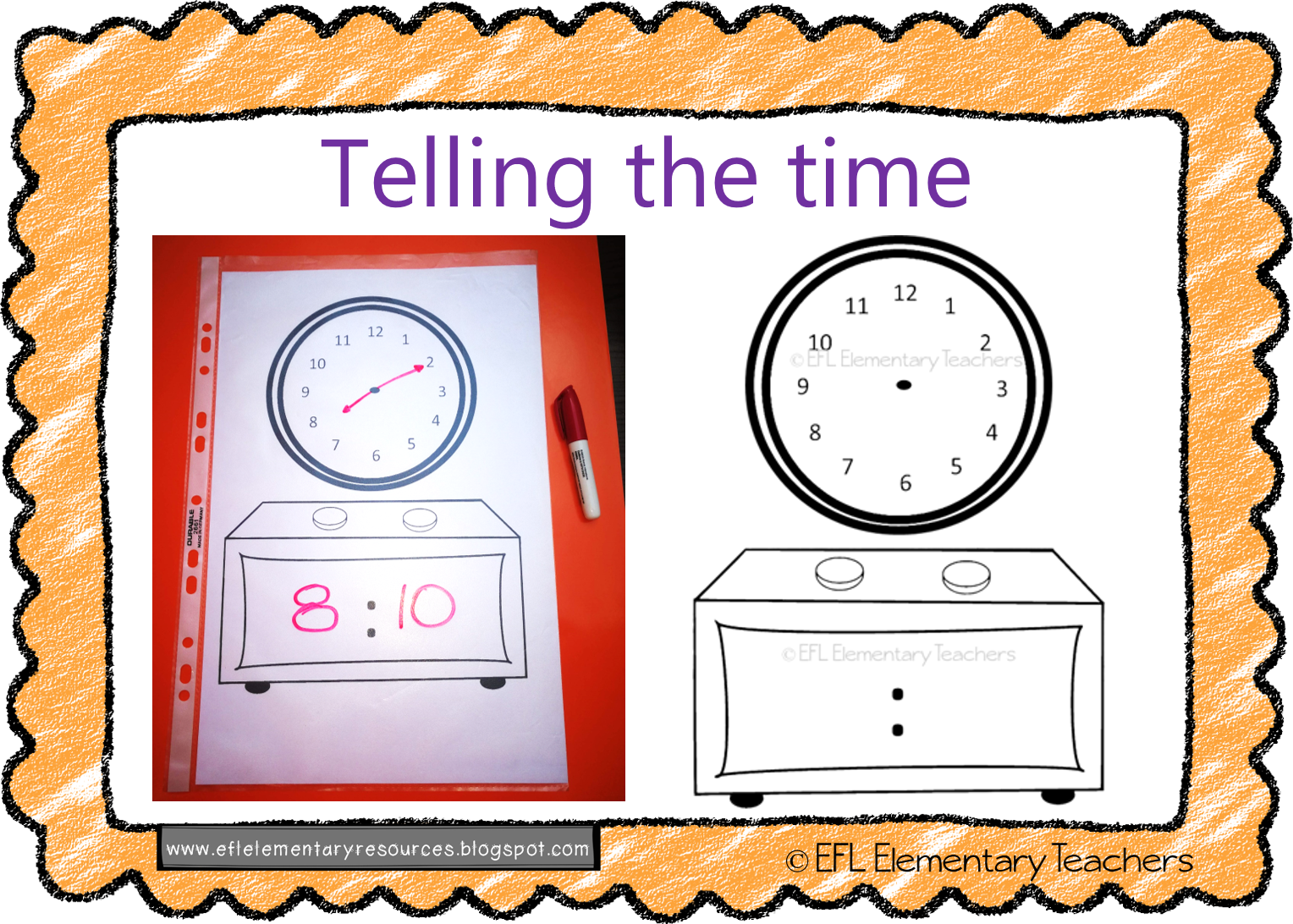
I made a bigger analog clock to place on the board and write the vocabulary next to each number or the digital numbers. Students will create their own clock and words with a smaller worksheet.
Large analog clock board ESL teaching tool

Write different times on the board and have the students come to the front and put the corresponding flashcard.
ESL time teaching activity with flashcards

Worksheet Listening and Writing Practice
Hand in the worksheet for multiple listening practice. Insert the worksheet into a clear plastic sheet for next use.
Telling time listening worksheet ESL activity

Or cut them and place contact paper on each one to write the time.
Telling time listening worksheet ESL activity
               
And another worksheet for writing practice.

Telling time writing worksheet ESL learners

Listening is another skill that show be reinforced for teaching the time.

Students practicing telling time with clocks ESL worksheets

Craft Clock Activity

On the art side of the lesson plan include creating a clock. It will be fun to do an analog clock. Have them decorate their clock as they wish using glitter, sequins and any other decoration. Students can glue the printable onto construction paper, cardboard or fun foam. After cutting the clock hands, they can attach them using a butterfly clip.
Have the students play in pairs using the clock they made.
Student A: It’s a quarter to three.
Student B: (demonstrates using his clock)

Student-made analog clock craft ESL activity

           Or do a label the clock. Either digital or analog.

Students practicing telling time with clocks ESL

time esl

Interactive Games for Time Practice
 Hand in a small clock and a slip of paper to each student. Have them write the time on the slip of paper. Get all the slips of paper and small cards.  Divide the class into two groups, one with the clock cards and another with the slips of paper. At your signal, students stand up and walk around finding the correct pair.

time cards ESL classroom game

Dictation using the flashcards. Grab all the flashcards that you want to review and without showing them, dictate to the students the time. They write them down on the down on their notebooks. Then place them on the board and have the students correct their work.

Time dictation ESL listening practice

        Match the digital clock and the analog clock cards.

Matching time cards ESL classroom game

              A worksheet that is game board. Play with dice.

Telling time board game worksheet ESL activity

Role-Play Conversations

After all this, model a small role play and then have students practice in pairs.
Teacher: Excuse me, What time is it ?
Student A using his clock: It’s three o’clock.
Teacher: Thank you.
Student A: You’re welcome.

Take extra time for teaching: Morning, noon, afternoon, evening, night, midnight. Use the flashcards and the digital cutout clocks. You might want to point out Good morning! And I defined some hours. Usually morning starts at sunrise and night starts at sunset but it varies depending on the country.

Telling time role play ESL speaking activity


Follow me! There is more to come. Leave your comments!